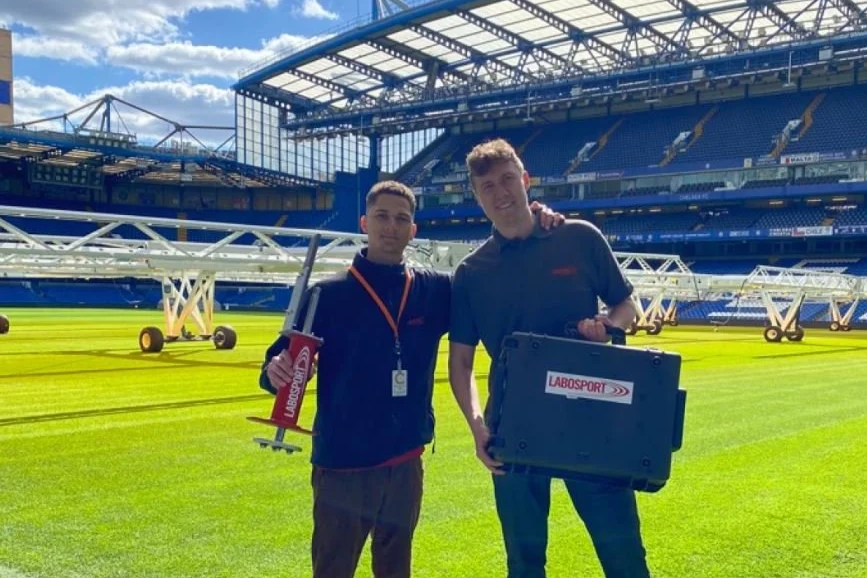
Labosport Surface Testing Dissertation
Bachelor of Science in Sports Science Dissertation
Rotational Resistance and Vertical Compliance in Modern Football Pitches
Project Overview
This bachelor project investigates how modern football pitches differ in their mechanical properties and how those differences influence player biomechanics, performance, and injury risk. As artificial and hybrid playing surfaces become increasingly common in elite and amateur football, understanding how these surfaces behave mechanically—and how players interact with them—has become a critical issue for governing bodies such as FIFA.
The project was conducted in cooperation with Labosport and focuses on two core surface characteristics: rotational resistance and vertical compliance. Using updated FIFA-approved testing equipment, the study evaluates whether current FIFA Quality benchmarks accurately reflect player experience and whether they should be revised based on newer biomechanical evidence.
Research Motivation
Third-generation (3G) artificial turf has grown rapidly due to its durability, weather resistance, and ability to withstand heavy usage. While FIFA has approved these surfaces for professional competition, concerns remain regarding how artificial, natural, and hybrid pitches differ in traction, stiffness, and shock absorption—and how those differences affect athletes during cutting, turning, landing, and running movements.
Recent research has shown that traditional surface testing devices correlate only weakly with player perception. In response, Labosport and Loughborough University introduced updated testing systems designed to better reflect how players actually experience pitch mechanics. This project uses those updated systems to reassess surface performance across multiple pitch types.
Research Question
How are natural and hybrid football pitches characterized in terms of rotational resistance and vertical compliance compared to modern 3G pitches, and how do these surface differences influence biomechanical response?
Key Mechanical Concepts
Rotational Resistance
Rotational resistance describes how much torque a surface resists when a studded foot rotates against it. This property is critical during football actions such as cutting, pivoting, and rapid changes of direction.
Excessive rotational resistance may increase joint loading and injury risk, particularly at the ankle, knee, and hip. Too little resistance, however, increases the likelihood of slipping and performance loss. The challenge is identifying an optimal balance that maximizes performance while minimizing injury risk.
Vertical Compliance
Vertical compliance describes how a surface responds to vertical loading and includes three key parameters:
Shock Absorption (SA): how much impact force the surface absorbs relative to concrete
Vertical Deformation (VD): how much the surface compresses under load
Energy Restitution (ER): how much energy is returned to the athlete after impact
These properties influence comfort, fatigue, joint loading, and movement efficiency during running, landing, and jumping.
Measurement Technology
Rotational Traction Athlete (RTA)
Rotational resistance was measured using the Rotational Traction Athlete, an updated version of FIFA’s traditional rotational traction tester. Unlike older devices, the RTA records torque continuously across the full rotation angle, allowing for detailed analysis of how resistance develops during movement.
Key outputs included:
Secondary Stiffness (SS): resistance during early rotational movement
Peak Torque (PT): maximum rotational resistance
Angle at Peak Torque (APT): rotation angle where maximum resistance occurs
Secondary stiffness received particular attention due to its stronger correlation with player perception compared to peak torque alone.
New Advanced Artificial Athlete (NAAA)
Vertical compliance was measured using the New Advanced Artificial Athlete. This device drops a controlled mass onto the surface and measures acceleration throughout impact to calculate shock absorption, vertical deformation, and energy restitution.
Recent algorithm updates improved the device’s correlation with player perception by redefining surface contact thresholds and energy restitution calculations, making it more representative of real-world interactions.
Methods and Data Collection
Data was collected from 90 football pitches across different surface types, including:
Natural grass
Hybrid grass
3G FIFA Quality
3G FIFA Quality Pro
Testing was conducted in cooperation with Labosport and included measurements from multiple pitch locations to assess both performance and consistency. Rotational resistance tests were performed at key playing zones, while vertical compliance tests measured impact response at multiple points per pitch.
Statistical analysis included descriptive statistics, ANOVA testing, post-hoc comparisons, and consistency assessments using coefficients of variation.
Results: Rotational Resistance
The results showed clear mechanical differences between surface types:
3G FIFA Quality Pro pitches exhibited the highest secondary stiffness, indicating greater resistance during early rotational movement.
Hybrid pitches showed the highest peak torque, suggesting strong traction under maximal load.
Natural pitches demonstrated greater variability, reflecting sensitivity to wear, maintenance, and environmental conditions.
Secondary stiffness differed significantly between 3G FIFA Quality Pro surfaces and all other pitch types, reinforcing its importance as a meaningful traction metric.
Results: Vertical Compliance
Vertical compliance measurements revealed additional contrasts:
Hybrid pitches showed the lowest shock absorption, indicating firmer surfaces.
3G pitches exhibited higher energy restitution and greater vertical deformation, meaning they returned more energy to the player after impact.
Natural pitches displayed the greatest variability across all vertical compliance parameters.
These findings highlight how artificial surfaces can feel more responsive but may alter loading patterns compared to natural and hybrid grass.
Biomechanical Implications
Existing biomechanics literature suggests that higher traction surfaces allow players to generate greater forces during cutting and turning but may increase joint loading and injury risk. Similarly, surface stiffness influences how muscles and tendons behave as a spring system during locomotion.
The results of this project support the idea that no single surface parameter fully defines player safety or performance. Instead, the interaction between rotational resistance, vertical compliance, and consistency across the pitch plays a critical role.
Importantly, many mechanical test results align more closely with player perception than with direct biomechanical measurements, emphasizing the need for updated testing frameworks.
Evaluation and Limitations
While the study used state-of-the-art testing equipment and a large dataset, limitations remain:
Mechanical tests do not perfectly replicate human movement mechanics.
Rotational tests involve larger rotation angles than typically observed in players.
Vertical compliance testing simulates heel impacts rather than forefoot loading.
Environmental factors such as temperature and moisture were not isolated.
Despite these limitations, the study provides valuable insight into surface behavior at scale.
Conclusion
This project demonstrates that modern football pitches differ significantly in both rotational resistance and vertical compliance. 3G surfaces—particularly FIFA Quality Pro pitches—exhibit higher rotational stiffness, while hybrid pitches offer firmer, more stable characteristics.
The findings support growing evidence that current FIFA Quality benchmarks should be revised to reflect updated testing technology and stronger correlations with player perception. The work contributes to ongoing discussions about how best to balance performance, safety, and consistency in elite football surfaces.
Skills Demonstrated
Biomechanics and sports surface analysis
Experimental design and field testing
Statistical analysis and data interpretation
Applied physics and mechanical modeling
Translating research into applied recommendations
Collaboration with industry partners