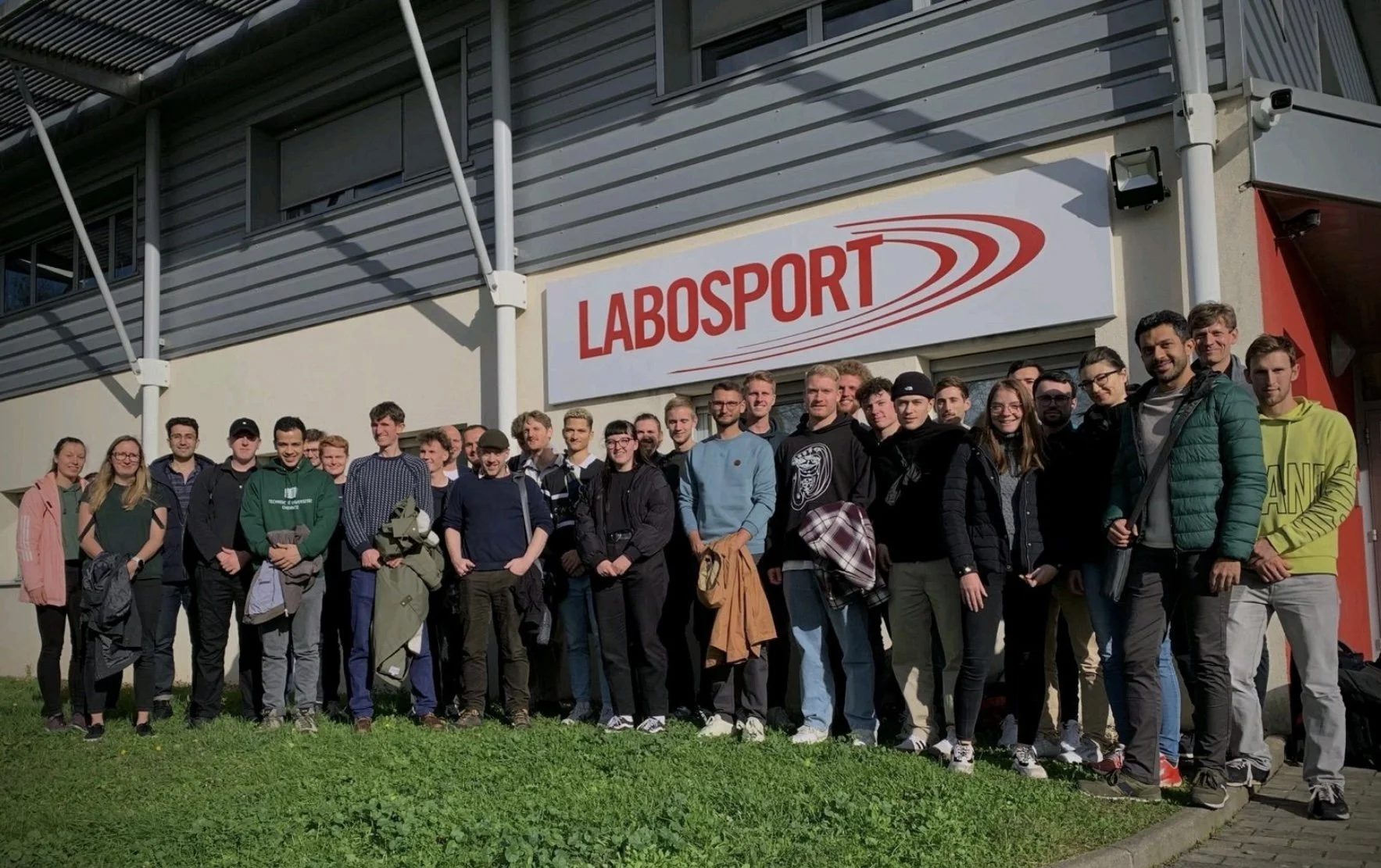
Labosport Innovation Market Place
Innovation Challenge set by Labosport in collaboration with the Alliance for Sports Engineering Education
Labodots: Linking Player Perception and Biomechanics in Sports Surface Testing
Project Overview
This project was developed as part of the Alliance for Sports Engineering Education’s Innovation Marketplace program, where student teams collaborate with industry partners to solve real-world engineering challenges. Our partner for this project was Labosport, a global sports surface testing and consulting company working with elite football clubs and governing bodies.
Labosport presented a core problem they were facing in practice: mechanical test data from standard surface testing rigs often failed to align with how players perceived different football surfaces. In particular, laboratory data suggested that artificial turf surfaces exhibited greater shock absorption than natural and hybrid pitches, yet players consistently reported that artificial turf felt harder and less comfortable to play on. This discrepancy raised concerns about whether existing testing methods truly capture how surfaces are experienced by athletes.
Our task was to design a new testing concept that could bridge the gap between objective mechanical measurements and subjective player perception.
Concept Development: Labodots
Over the course of two months, my group and I developed and presented Labodots, a concept built around the integration of wearable sensor data and immediate player feedback.
Labodots is designed as an app-based testing framework that combines:
Qualitative data, collected through short surveys assessing perceived surface hardness and comfort
Quantitative biomechanical data, collected using inertial measurement units (IMUs)
The core idea was to measure how players actually interact with the surface while simultaneously capturing how they feel about it, allowing for direct correlation between perception and biomechanics.
Measurement Approach
The proposed testing setup involved players wearing IMUs attached to the foot, shank, and thigh. These sensors measure acceleration during ground contact, providing insight into impact forces transmitted through the lower limb.
Players performed a jump-based task on different surface types, after which they immediately completed a short survey rating:
Perceived surface hardness
Overall comfort during landing
The IMU data captured peak accelerations during landing, which were used as an objective indicator of surface hardness and impact loading.
During the development process, feedback and reflection led to an important design refinement: rather than using a counter-movement jump, a controlled drop from an elevated surface was identified as a more repeatable and surface-focused test. This adjustment would reduce variability introduced by individual jump technique and better isolate surface properties.
Experimental Findings
Preliminary testing compared artificial turf and vinyl sports flooring. The results highlighted the core dilemma motivating the project:
Artificial turf produced significantly higher peak accelerations, indicating greater impact forces
Despite this, players consistently rated vinyl flooring as more comfortable and less hard
No direct correlation was found between peak acceleration values and perceived hardness or comfort
These findings reinforced the idea that single mechanical metrics are insufficient to explain player experience, and that perception is influenced by a more complex interaction of biomechanics, surface response, and sensory feedback.
Key Insights and Impact
This project demonstrated that discrepancies between laboratory surface tests and player perception are not trivial measurement errors, but structural limitations of existing testing approaches. Labodots proposes a shift toward player-centered surface evaluation, where perception data is treated as a core variable rather than an afterthought.
By combining wearable sensor data with subjective feedback, the concept provides a pathway toward:
More representative surface testing protocols
Improved alignment between mechanical benchmarks and athlete experience
Better-informed decisions in surface design, certification, and regulation
It is also important to consider that performing a jump test has its flaws in terms of repeatability and the test should, therefore, be performed using a drop from an elevated platform.
Skills Demonstrated
Sports engineering and biomechanics
Wearable sensor data collection (IMUs)
Experimental design and test concept development
Translating industry problems into engineering solutions
Human-centered measurement approaches
Team-based innovation and industry collaboration