Lacoste Project: Exploring Novel Methods for Measuring In-Shoe Foot Movement
Project Overview
This project investigated a non-destructive method for measuring foot movement inside footwear, with a specific focus on tennis, where rapid changes of direction place high mechanical demands on the foot–shoe interface. Researchers and footwear brands continue to seek reliable ways to quantify in-shoe motion without compromising shoe structure or interfering with natural movement.
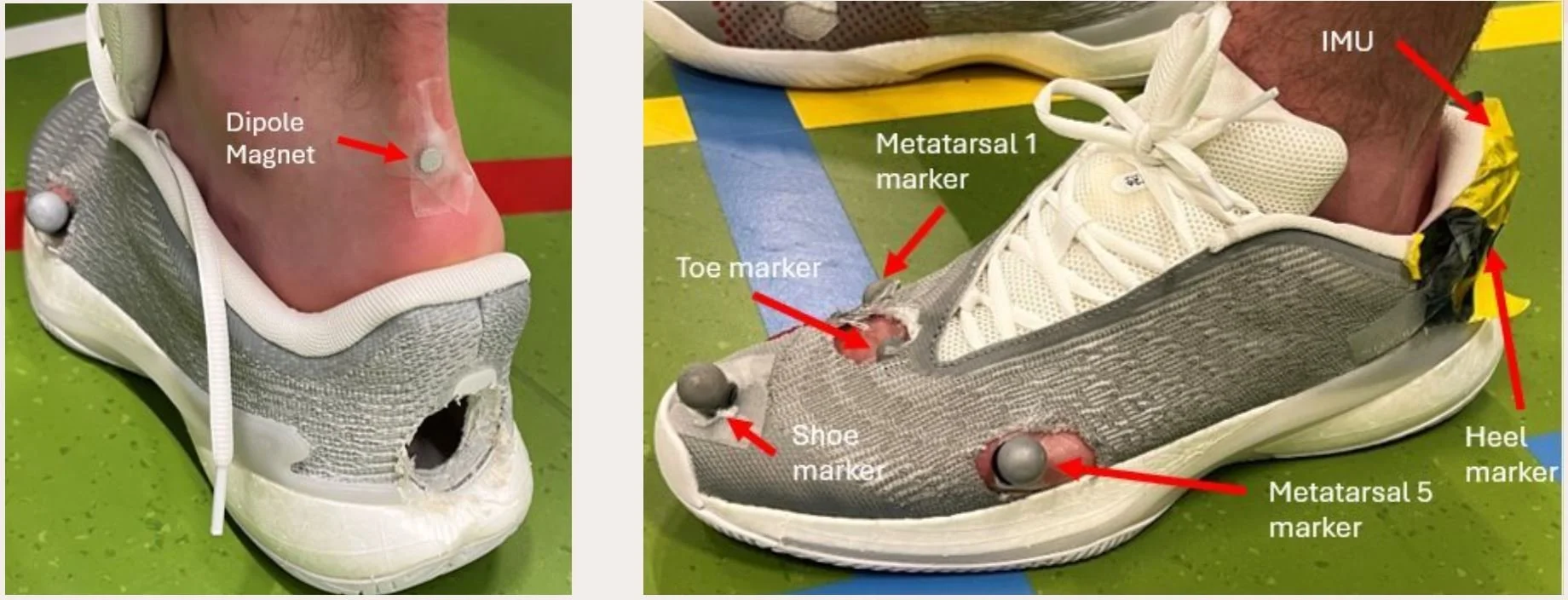
Existing approaches present clear limitations: cutting holes in shoes to accommodate motion capture markers compromises footwear integrity, while externally mounted markers or electromagnetic tracking systems can introduce measurement errors or disrupt movement. With recent improvements in smartphone-scale magnetometer and IMU technology, this project explored whether small neodymium magnets paired with magnetometers could be used to detect in-shoe inversion and eversion without modifying the shoe.
The objective was to evaluate whether magnetic field measurements could capture meaningful information about foot movement patterns and assess their potential as a low-cost alternative or complement to motion capture.
Measurement Concept and Experimental Setup
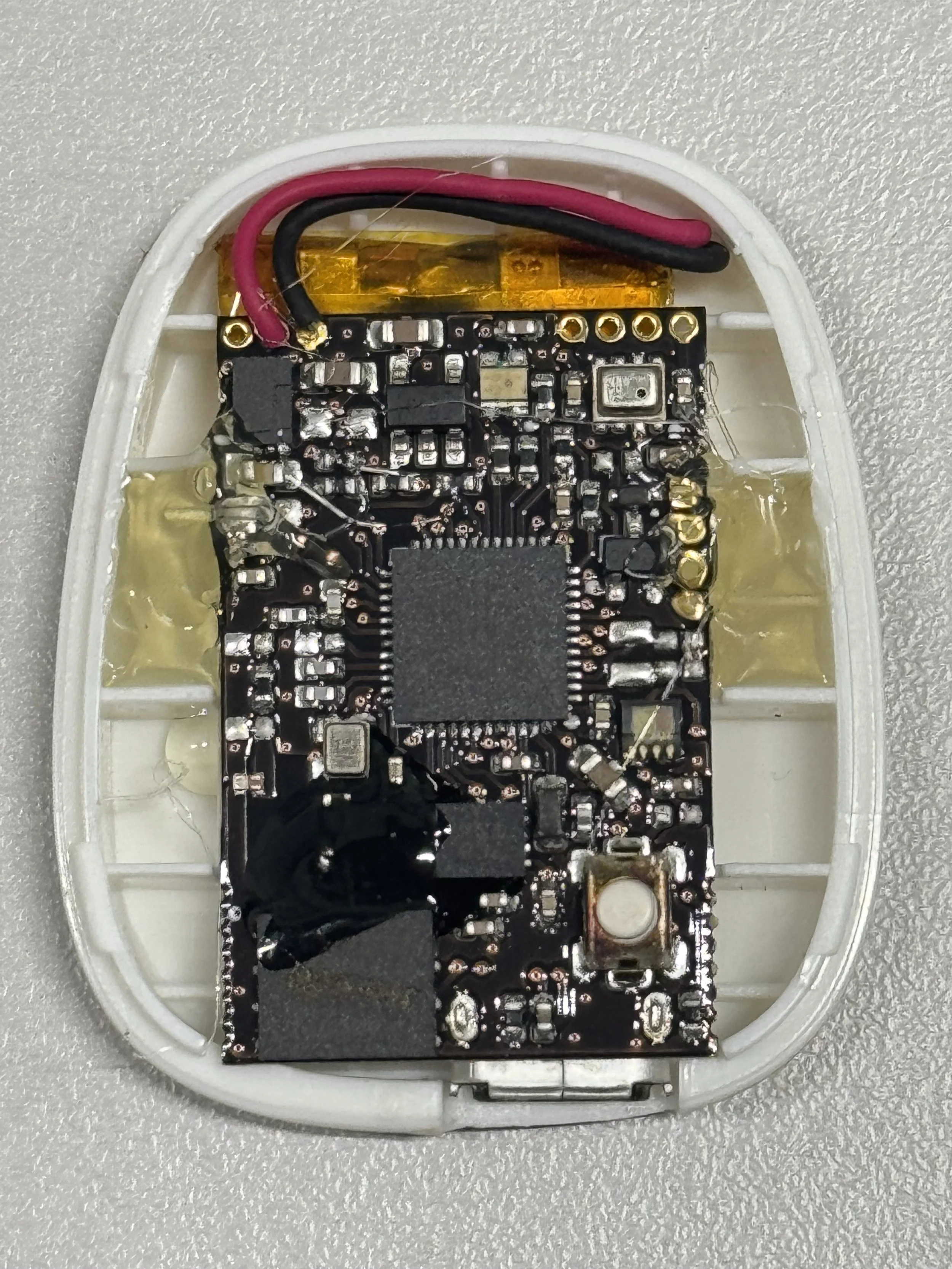
The proposed system consisted of a magnet–IMU pair, tested alongside a Qualisys motion capture system for reference. Initial experiments focused on understanding how magnetic field strength varied with sensor–magnet distance and orientation.
Key setup steps included:
Testing magnetic sensitivity across all three sensor axes (x, y, z)
Evaluating how field strength changed with distance
Identifying optimal magnet placement relative to the sensor
Preliminary results showed that magnet distances of approximately 1–2 cm produced the most sensitive and interpretable signals.
Sensor Characterization and Familiarization Testing
Two dedicated familiarization sessions were conducted to map magnetic field behavior across the three axes. These tests established a baseline understanding of how the magnetometer responded to changes in magnet position and orientation.
A lateral agility test was then used to compare magnetometer signals with motion capture data during tennis-relevant movements. However, challenges related to marker placement and the complexity of the collected datasets limited the ability to draw meaningful kinematic comparisons at this stage.
This phase highlighted the importance of simplifying movement tasks when validating novel sensing approaches.
Surrogate Model and Human Testing
To reduce experimental complexity, a surrogate shank model was introduced to replicate sensor–magnet distances observed during earlier testing. Both static and dynamic trials were conducted to confirm that the magnetic system could reliably detect changes in relative distance.
Following this, six-step walking trials were performed using a human participant. Walking was selected as a simple, repeatable movement to assess signal consistency under controlled conditions.
Across all trials, the system consistently detected changes in magnetic field strength corresponding to variations in heel-to-sensor distance.
Results and Interpretation
The magnetic system reliably identified:
Discrete steps
Overall movement patterns
Timing of foot motion events
Three-dimensional plots of the magnetic field vectors provided a qualitative representation of movement. However, the system could not accurately resolve precise positional changes. This limitation is inherent to magnetometers, which measure magnetic field strength rather than position. The relationship between field strength and distance is nonlinear and directionally ambiguous, preventing direct reconstruction of kinematics.
As a result, while the system captured the presence and timing of movement, it could not provide the spatial accuracy required for detailed kinematic analysis.
Key Insights and Research Implications
This project demonstrated that magnetometers paired with small magnets have potential as a lightweight, low-cost, and non-destructive method for identifying basic in-shoe foot movement patterns. However, they cannot currently replace motion capture for precise kinematic measurement.
The findings suggest that magnetic tracking may be most valuable as a complementary tool, offering insight into foot–shoe interaction and movement timing in situations where traditional motion capture is impractical.
Future work should focus on:
Optimizing magnet and sensor placement
Further isolating and analyzing individual sensor axes, particularly the z-axis
Validating the approach using more controlled and task-specific movement
Skills Demonstrated
Experimental sensor validation and characterization
Wearable and embedded sensing systems
Motion capture integration and comparison
Signal interpretation and data visualization
Critical evaluation of measurement limitations
Applied research in sports footwear biomechanics